

From a denial to a letter you can sign.
$631
written off — for now
01
Upload the EOB.
Patient identity is stripped in your browser before anything is sent.
Each claim matched to the payer's own rules — and the law.
- Coverage policyLCD L37373
- Federal regulation45 CFR §147.136
- Coding editNCCI
Every source quoted verbatim
02
Merits builds the case.
Your exact code and payer, matched to their published policy, federal law, and 40,000+ external-review rulings.
Ready to sign
+ checklist · where to file
03
Review, sign, send.
The letter, the attachment checklist, and where to file it.
What does your denial code mean?
Pick a common one — or type any code. If it's rarely worth appealing, we say so.
Why was your claim denied?
Not medically necessaryCO-50
The payer doesn't deem the service medically necessary.
Worth appealing. 4 to 5 of every 10 appealed denials get paid — and this is one Merits builds a cited case for.
Checked here free — you only pay if you decide to appeal.
Built so it can't invent a citation.
A general AI writes from memory and invents citations to fill the gaps. Merits quotes only from a closed library of named sources, and re-checks every quote against its original before you see it.
Closed librarymatched to your code & payerquoted verbatimre-checked at the source
- APayer medical policies484 · 43 insurers
- BMedicare coverage determinationsLCD · NCD
- CExternal-review rulings40,000+
- DFDA-approved drug labels240
- ECoding rules — NCCI · ICD-10 · HCPCS1.7M
- FFederal appeal law — ERISA · ACA · Medicareverbatim
- GClinical & specialty guidelinesUSPSTF · ACR
- HState external-review rules50 states + DC
verified at source · re-checked on every citation · structurally prevents invention
See the full evidence stack →A dead source drops from the pool automatically; anything unsupported is flagged for your review, never stated as fact. AI-assisted drafting — you review, sign, and submit under your own name. Merits gives no legal or medical advice and guarantees no outcome.
It argues from their own rules
84 Cigna policies on file. 61 Aetna. 43 insurers in all.
4 to 5 of every 10 appealed denials get paid.
Yet most are never filed at all. KFF 2024 · NY DFS 2025
The patient's identity never reaches our servers.
Name, member ID, and date of birth are stripped in your browser before anything is sent. Your device restores them into the finished letter. We never learn who the patient is.
De-identification follows the HIPAA Safe Harbor method (45 CFR §164.514(b)(2)) — and it happens in your browser.
See exactly how it works →Cheaper than the rework. Far cheaper than the write-off.
Cost of one denial, worked
per claim
- Rework in-house — staff time1
- $25–$118
- Merits appeal — complete, cited, about a minute
- $9
- In volume, per letter
- $5
- What stays yours, per denial
- $16–$109
And a large share of denials are never appealed at all — most of that money is simply written off.2
Appeal every month? 20 letters for $20 →One flat price to fight
$9 a letter · $5 in volume
Never a percentage of what you recover.
No contract
Pay per use, or an optional $20/mo plan — cancel any time, no lock-in.
Nothing to install
It's a web page — no IT project, no integration, no onboarding call.
Pay per denial
Buy a single letter, or credits in volume — you only pay to fight.
1. Industry estimates for processing/reworking a denied claim: Becker's, Change Healthcare, MGMA. 2. Industry denial-rework studies; figures vary by setting and are not a guarantee of any outcome.
What you'd use instead.
cites: 45 CFR §149.930(b)(4)
no such section exists
A general AI
will draft it in minutes. It will also cite a regulation that doesn't exist, on a letter with your signature at the bottom.
7:40 pm → 9:05 pm · one appeal
Doing it yourself
works. It costs the hour you were going to spend on patients, or at home.
Master service agreement
p. 1 of 38 · exhibit C: data-sharing terms
Denial software
is built for hospital systems: a contract, an integration project, and your data living on their servers.
Built for the people who fight denials.
Two desks, the same backlog. Merits sits on both.
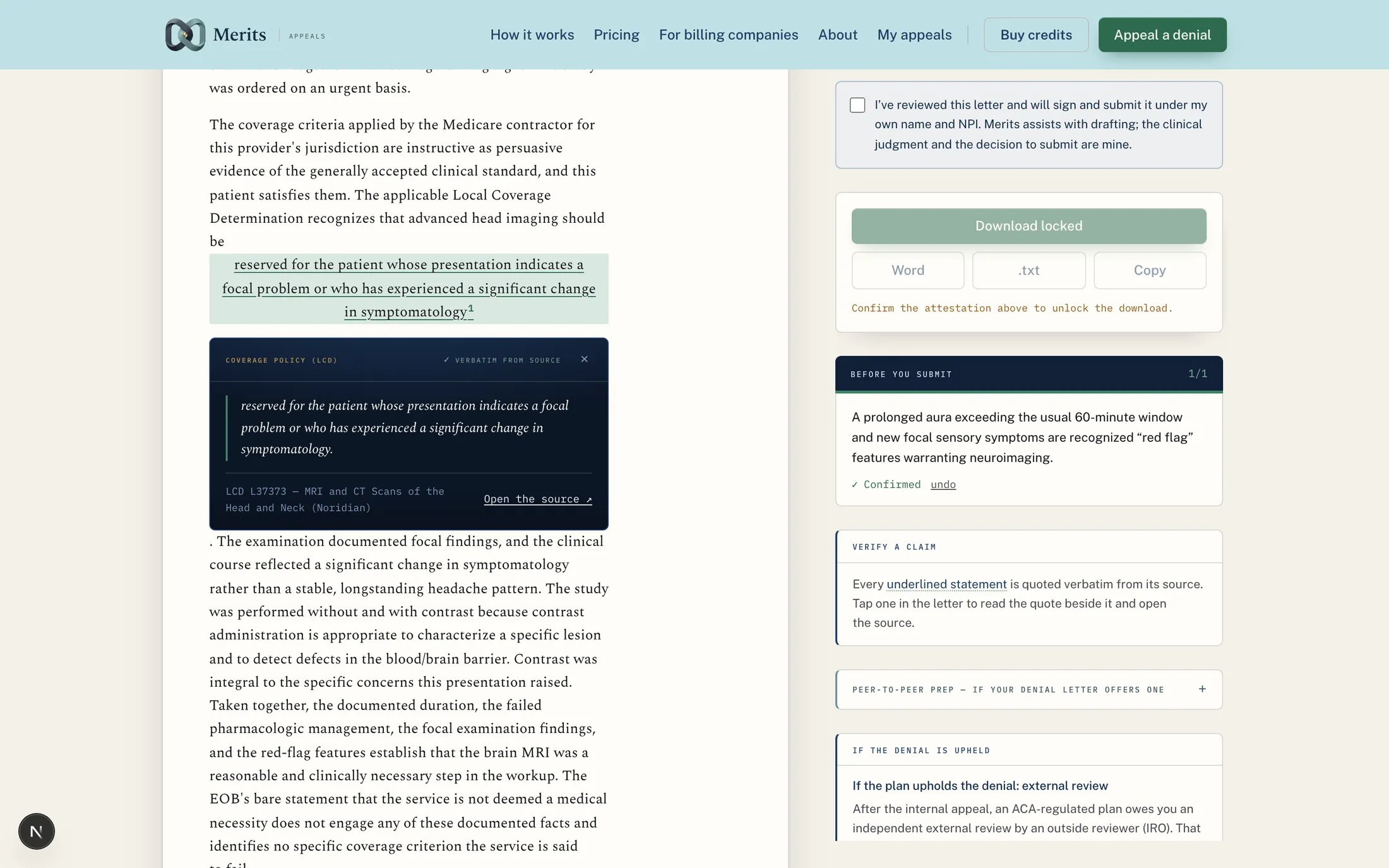
Product shown with sample data.
Physicians & small practices
No appeals desk, no evening to spare. Upload the denial, review the letter, sign it.
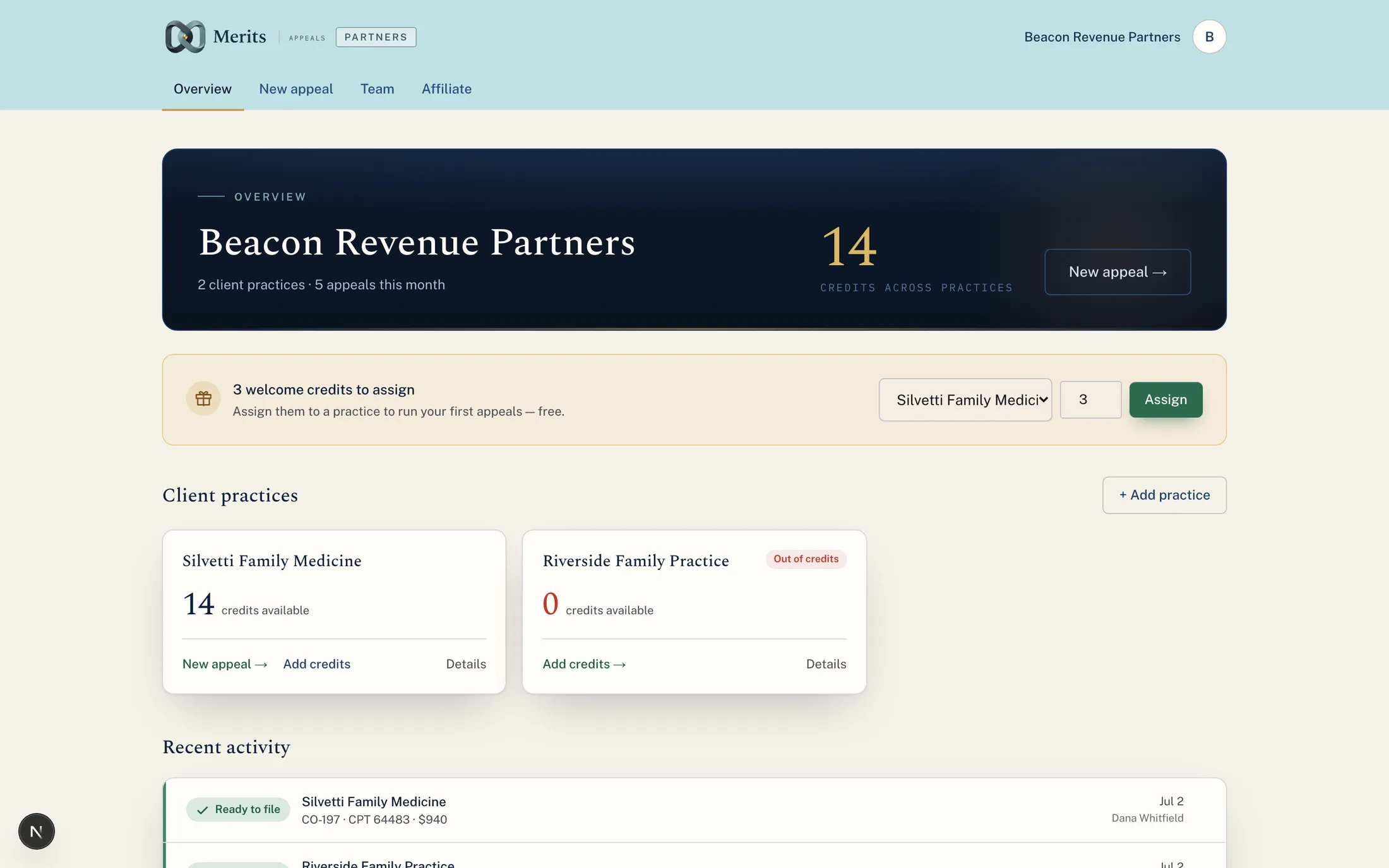
Product shown with sample data.
Billing & RCM companies
Turn the appeals you can't price into a service you can. One account for every client practice, pooled credits, and a recurring referral commission.
Two ways to pay.
Pay as you go
One denied claim, turned into an appeal letter you can sign and send.
- Nothing is charged until your letter is ready to review.
- Credits never expire · no account, no contract.
Merits · Membership
20 letters each month — that's $1 a letter.
- 20% off every extra letter.
- 2 months free on the annual plan.
- Cancel anytime — no contract.
Appealing three or more denials a month? Membership pays for itself.
Become a memberCredit packs are built for billing teams and anyone who'd rather skip a subscription — pooled across client practices on a Partner account.
The data behind the fight.
Data journalism on the denial economy — 34 pieces, every figure linked to its primary source.
The $25.7 Billion Rework
What administering denials costs the American provider every year.
ReadThe Pledge Tracker
What ~60 insurers promised for 2026 and 2027 — against what physicians report.
ReadLess Than 1%: America's Appeal Gap
85 million denied claims, 262,982 appeals — the funnel of giving up, told only with public data.
Read
Most denials are never appealed. The letter just never gets written.
What stops it? The hour it takes — and the risk of a made-up citation on a page you sign. Merits removes both.